
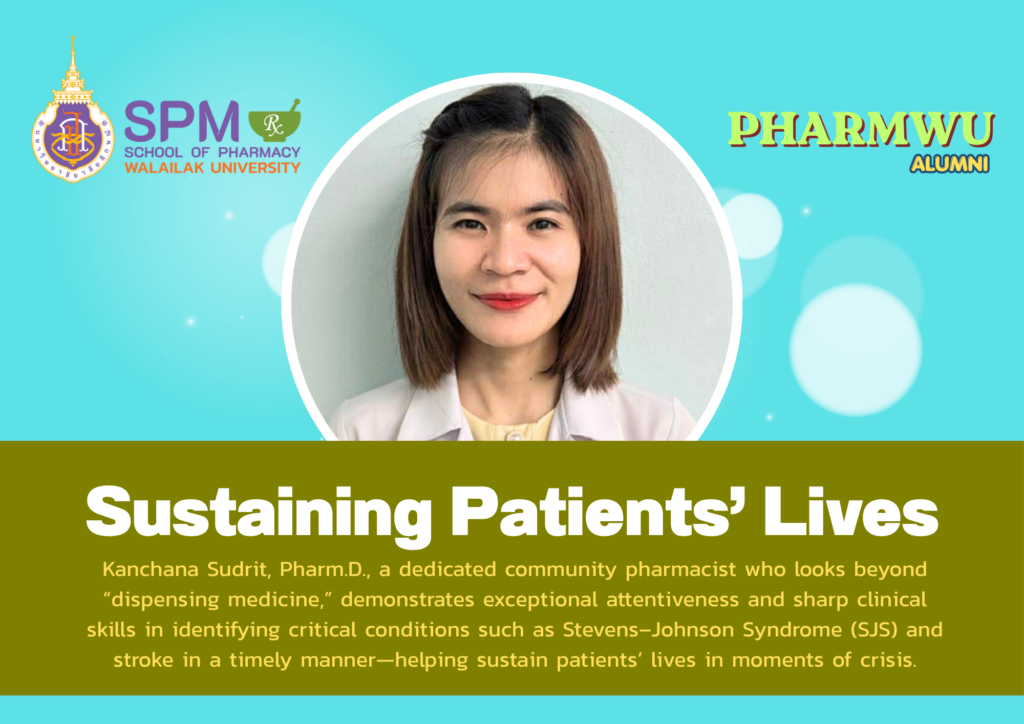
NAKHON SI THAMMARAT, Thailand — A community pharmacist in southern Thailand is being praised for her vigilance and professional judgment after successfully identifying and referring two critical cases that could have resulted in life-threatening outcomes.
Kanchana Sudrit, Pharm.D., a graduate of the School of Pharmacy, Walailak University, has demonstrated that community pharmacies can serve as an essential frontline in the healthcare system, going beyond routine dispensing to provide early detection and intervention.
In one case, a relative visited her pharmacy seeking treatment for what appeared to be a simple diaper rash. However, upon further inquiry, Kanchana identified alarming symptoms, including drowsiness and facial swelling, in a patient who had recently started a new anticonvulsant. She suspected Stevens–Johnson Syndrome (SJS), a rare but severe adverse drug reaction. Despite challenges in immediate hospital access, she coordinated closely with a specialist and monitored the patient until the condition stabilized.
In another incident, a female patient presented with a severe headache. Kanchana observed subtle neurological signs and conducted a FAST assessment, indicating a possible stroke. The patient was promptly referred for imaging, which confirmed an ischemic stroke. Early intervention enabled timely treatment, with hospital physicians later acknowledging the pharmacist’s role in the patient’s outcome.
These cases underscore the critical role of community pharmacists in patient safety and early diagnosis. Kanchana’s approach—marked by careful questioning and clinical awareness—has been credited with preventing potentially fatal complications.
The School of Pharmacy, Walailak University, commended her as a role model for future pharmacists, highlighting her dedication, clinical competence, and commitment to public health.
Kanchana currently operates a community pharmacy in Sichon District and also serves as an inpatient pharmacist at Sichon Hospital in Nakhon Si Thammarat.
Reporting for public health awareness, this is a reminder that timely attention and professional care at the community level can make a life-saving difference.